
Our core business modelis the discovery, development, and commercialization of ADC assets. Our drug development capabilities are built on integrated in-house expertise that covers the entire R&D process—from project initiation and target discovery to preclinical studies and clinical development.
Currently, multiple product candidates have advanced to Phase I or Phase II dose expansion stages, and each product ranks among the global leaders in clinical progress within its respective drug class targeting the same therapeutic targets.
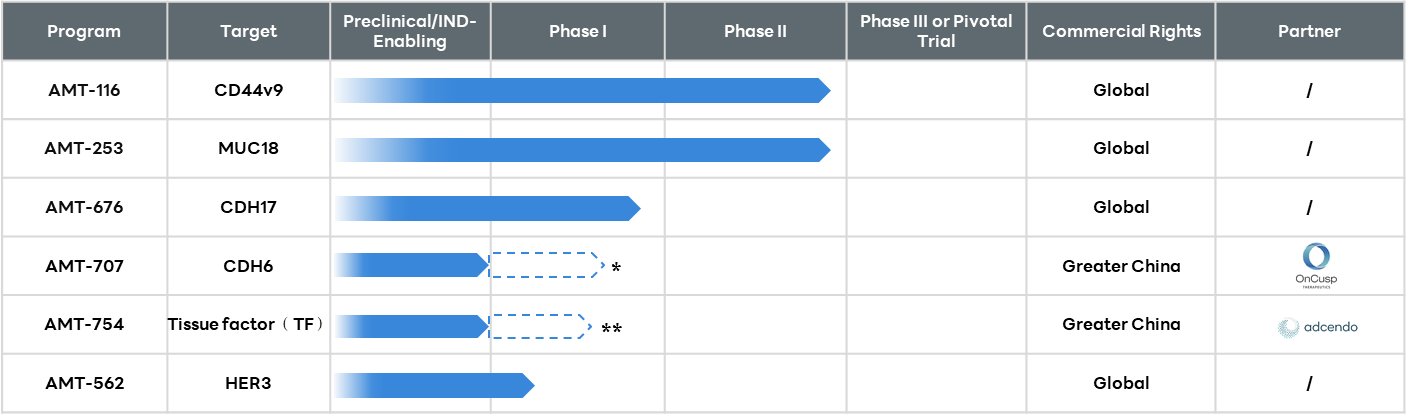
* Phase Ia clinical trial of AMT-707 (NCT06234423) in the U.S. is sponsored and being conducted by our partner, OnCusp Therapeutics Inc.
** Phase I clinical trial of AMT-754 (NCT06597721) in the U.S. and Australia is sponsored and being conducted by our partner, Adcendo ApS
Our Core and Key Pipelines
AMT-116 is the world’s first and only clinical-stage ADC targeting CD44v9, designed for the treatment of NSCLC and other solid tumors. AMT-116 comprises a humanized anti-CD44v9 IgG1 antibody developed on our proprietary MabArray target discovery platform, conjugated to a novel TOP1 inhibitor payload via a hydrolysable linker, with a DAR of 8. The overall ADC was independently engineered by us, including the discovery and optimization of the CD44v9-targeted antibody and the subsequent integration of the linker-payload system. We have also conducted substantial R&D activities for this program, covering target selection, conjugation process development, preclinical pharmacology and toxicology studies, CMC development, and clinical trial design.
AMT-253 is the world’s first and only clinical-stage ADC targeting MUC18, intended for the treatment of melanoma and gynecologic cancers. AMT-253 consists of a humanized MUC18-specific IgG1 antibody developed on our proprietary MabArray target discovery platform, conjugated to a potent TOP1 inhibitor payload through a protease-sensitive, polysarcosine-modified peptide linker (T1000), at a DAR of 8. We optimized the structure design of AMT-253 to enable targeted delivery of the cytotoxic payload to MUC18-expressing tumor cells while minimizing off-target toxicity and enhancing systemic stability. The ADC was independently engineered by us, encompassing the discovery and optimization of the MUC18-targeted antibody and the subsequent integration of the linker-payload system. Across the AMT-253 program, we have carried out extensive R&D activities, including target selection and validation, conjugation process development, preclinical pharmacology and toxicology studies, CMC development, and clinical trial design.
A Cell Surface-Binding Antibody Atlas Nominates a MUC18-Directed Antibody-Drug Conjugate for Targeting Melanoma. Cancer Res. 2023;83(22):3783-3795. doi:10.1158/0008-5472.CAN-23-1356
AMT-676 is the world’s first clinical-stage CDH17-targeted ADC, intended for the treatment of CRC and other solid tumors. AMT-676 consists of a proprietary humanized CDH17-specific IgG1 antibody developed on our MabArray target discovery platform, conjugated to a potent TOP1 inhibitor payload through a protease-cleavable peptide linker (T1000). AMT-676 incorporates a DAR of 4 on the T1000 linker-exatecan platform, leveraging Exatecan’s favorable bystander effect, tumor penetration and resistance to MDR efflux while balancing its tolerability.
AMT-562 is a HER3-targeted ADC. It consists of a humanized HER3-specific IgG1 monoclonal antibody conjugated to exatecan, a potent and clinically validated TOP1 inhibitor, via an optimized self-immolative para-aminobenzyloxycarbonyl (PABC) spacer, with an average DAR of 8. The design of AMT-562 leverages the unique pharmacologic profile of exatecan and a highly stable linker system to enhance tumor penetration, improve therapeutic index, and maintain favorable systemic tolerability. Preclinical studies demonstrated that AMT-562 achieves strong and durable antitumor activity with better efficacy and longer duration of response compared with benchmark HER3-targeted ADCs, while maintaining a manageable toxicity profile.
AMT-562, a Novel HER3-targeting Antibody-Drug Conjugate, Demonstrates a Potential to Broaden Therapeutic Opportunities for HER3-expressing Tumors. Mol Cancer Ther. 2023;22(9):1013-1027. doi:10.1158/1535-7163.MCT-23-0198
AMT-707 is a CDH6 ADC candidate. It consists of a humanized CDH6-specific IgG1 monoclonal antibody conjugated to a potent and clinically validated TOP1 inhibitor, exatecan, through a proprietary protease-sensitive polysarcosine-modified peptide linker, with an average DAR of 8. Preclinical studies demonstrated that AMT-707 exhibited potent and durable antitumor activity across multiple tumor models, including ovarian, kidney and cholangiocarcinoma.
AMT-754 is a TF-targeted ADC candidate. AMT-754 is composed of a humanized anti-TF IgG1 antibody conjugated to exatecan, a potent TOP1 inhibitor, via a protease-cleavable Val-Ala (VA) dipeptide linker, with an average DAR of 4. The conjugate design features a stable, cathepsin-sensitive hydrophilic linker and a non-P-gp substrate payload, resulting in enhanced bystander killing effect, high tumor penetration, and reduced off-target toxicity. Preclinical data have demonstrated robust antitumor activity across multiple TF-expressing tumor models, including pancreatic cancer, cervical cancer, and ovarian cancer, with a favorable safety and tolerability profile.